The Effect Of Corporate Financial Characteristics On Earnings Quality In The Consumer Non-Cyclicals Sector
Abstract
This research aims to empirically investigate the effect of liquidity, capital structure, earnings growth, capital intensity, and firm size on earnings quality. The consumer non-cyclicals sector was chosen because it is defensive in nature and its demand tends to be stable amidst economic uncertainty, making the quality of earnings information crucial to avoid misleading stakeholders in decision-making. Adopting a quantitative methodology, this study utilizes secondary data derived from the annual financial reports of firms registered on the Indonesia Stock Exchange (IDX) across the 2023–2025 period. Through purposive sampling method, yielding 117 valid observations after the elimination of extreme data (outliers). The data were analyzed utilizing multiple linear regression via IBM SPSS Statistics 27 software to examine the connections among the variables. The partial test results indicate that liquidity, capital structure, and earnings growth do not have a significant effect on earnings quality. Conversely, capital intensity and firm size are proven to have a positive and significant effect on earnings quality. Simultaneously, all independent variables significantly affect earnings quality with an Adjusted R Square value of 8.9%. These findings are expected to serve as empirical considerations for management in formulating financial policies, as well as for investors in assessing the reliability of earnings information before making investment decisions.
References
Bursa Efek Indonesia. (n.d.). Bursa Efek Indonesia. https://www.idx.co.id
Damayanti, S., & Atmaja, S. N. C. W. (2026). Pengaruh intensitas modal, investment opportunity set dan pertumbuhan laba terhadap kualitas laba (Studi empiris pada perusahaan consumer non-cyclicals di Bursa Efek Indonesia tahun 2019-2023). Jurnal Nusa Akuntansi, 3(3), 968–987.
Febriana, M., Aminah, & Afrizal. (2024). Determinants of earnings quality (Case study of mining sector manufacturing companies on the Indonesian Stock Exchange 2021-2022). International Journal of Economics, Management and Accounting, 1(9), 693–708. https://doi.org/10.47353/ijema.v1i9.100
Ghassany, A., Aurelia, S., Sujarminto, A., & Kay, P. B. T. A. (2024). Sustainable earnings dynamics: An analysis of influential factors on earnings quality in the transportation sector of the Indonesia Stock Exchange. International Journal of Business, Education, Humanities and Social Sciences, 6(2), 172–187.
Hair, J. F., Jr., Black, W. C., Babin, B. J., & Anderson, R. E. (2019). Multivariate data analysis (8th ed.). Cengage Learning EMEA.
Hasanuddin, R., Darman, D., Taufan, M. Y., Salim, A., Muslim, M., & Putra, A. H. P. K. (2021). The effect of firm size, debt, current ratio, and investment opportunity set on earnings quality: An empirical study in Indonesia. Journal of Asian Finance, Economics and Business, 8(6), 179–188. https://doi.org/10.13106/jafeb.2021.vol8.no6.0179
Janah, A. L., Agung, D. A., Putri, F. A., Nurtita, F., & Ayu, N. K. (2025). Analisis Kasus Manipulasi Laporan Keuangan Pada PT . Tiga Pilar Sejahtera Food, Tbk. dengan Financial Shenanigans. Cendekia: Jurnal Hukum, Sosial dan Humaniora, 3(2), 1085–1091.
Jensen, M. C., & Meckling, W. H. (1976). Theory of the firm: Managerial behavior, agency costs and ownership structure. Journal of Financial Economics, 3(4), 305–360.
Juwita, R. R., Prapanca, D., & Hariasih, M. (2024). Dampak likuiditas, pertumbuhan laba dan struktur modal terhadap kualitas laba perusahaan: Studi perusahaan manufaktur di Bursa Efek Indonesia (BEI). Journal of Economic, Bussines and Accounting (COSTING), 7(3), 6301–6310. https://doi.org/10.31539/costing.v7i3.9391
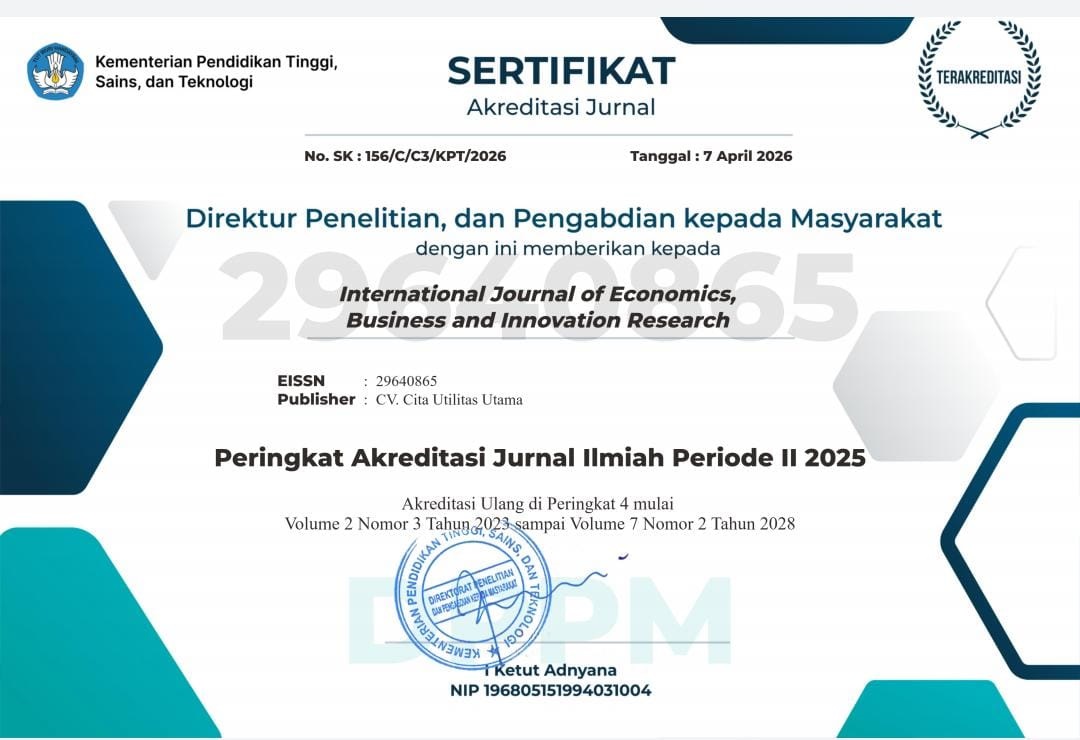
Nabilla, P. S., Miswaty, & Sutadji, I. M. (2026). Effects of firm size, liquidity, leverage, and investment opportunity set on earnings quality. International Journal of Economics, Business and Innovation Research, 5(5), 565–577.
Saragih, D. A. B., Tripermata, L., & Hendarmin, R. M. R. (2025). Pengaruh likuiditas, intensitas modal, dan profitabilitas terhadap kualitas laba pada bank BUMN yang terdaftar di Bursa Efek Indonesia periode tahun 2022–2024. AKUA: Jurnal Akuntansi dan Keuangan, 4(4), 795–801. https://doi.org/10.54259/akua.v4i4.5647
Septianti, E., & Pulungan, M. S. H. (2022). Pengaruh likuiditas, struktur modal, ukuran perusahaan, prospek pertumbuhan, kualitas audit dan profitabilitas terhadap kualitas laba [Skripsi sarjana, Institut Informatika dan Bisnis Darmajaya]. Repository IIB Darmajaya. https://repo.darmajaya.ac.id/7501/
Sholihah, Q., & Machdar, N. M. (2025). Analisis sustainable reporting disclosure, capital itensity, transaksi hubungan istimewa terhadap kualitas laba. Musytari: Neraca Akuntansi Manajemen, Ekonomi, 25(1). https://doi.org/10.8734/mnmae.v1i2.359
Spence, M. (1973). Job Market Signaling. The Quarterly Journal of Economics, 87(3), 355–374. https://doi.org/10.2307/1882010
Sulistyanto, S. (2018). Manajemen laba: Teori dan model empiris. PT Grasindo.
Tandelilin, E. (2022). Pasar modal: Manajemen portofolio & investasi. PT Kanisius.
Wibowo, H., & Sufiyati. (2025). The effect of capital structure, firm size, growth and investment opportunity set on earnings quality. International Journal of Application on Economics and Business, 4(2), 397–406. https://doi.org/10.24912/ijaeb.v4i2.397-406














 Contact Person +6282139474255
 Email : ijebir@citakonsultindo.or.id / editor.ijebir@gmail.com

